
By GreenPump Energy | greenpumpenergy.com
If you grew up thinking an air conditioner only cools and a furnace only heats, you are not alone. Most of the homeowners we visit are genuinely surprised to learn that one system can do both jobs and do them incredibly well.
As an HVAC Installer across Canada, we get asked the same question almost every single week: “How does a heat pump actually work?”
Here’s our guide on how a heat pump works, breaking down the practical, everyday science behind Canada’s most efficient heating and cooling solution.
Do Heat Pumps Heat and Cool?
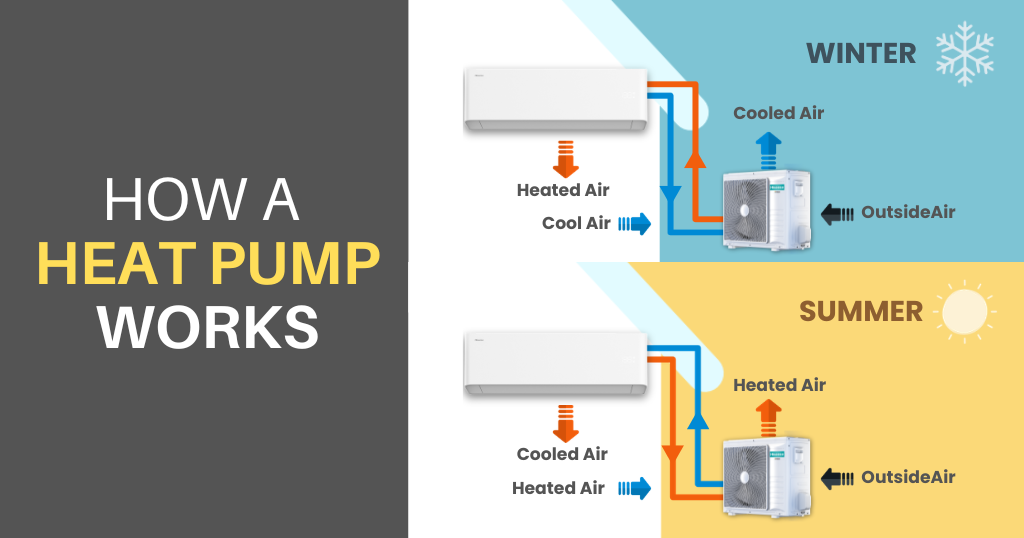
Yes, heat pumps both heat and cool. How they work is they do not create heat; they move it from one place to another using electrical energy and refrigerant. A gas or oil furnace burns fuel to produce heat from scratch. Electric baseboards convert electricity directly into warmth, one watt for one watt. A heat pump takes a completely different approach: it takes heat that already exists outside and moves it into your home. Because it transfers heat rather than creating it, the system can deliver up to three to four times more heat energy than the electricity it consumes.
The best mental model is your kitchen fridge. Your refrigerator pulls heat out of the food compartment and dumps it into your kitchen, that is why the back of the fridge feels warm. A heat pump is exactly the same machine, just with a switch that lets it run in either direction. In summer, it pulls heat from inside your house and dumps it outside. In our Canadian winters, it flips the script and brings heat from outside in.
Every system has two main components:
- The Outdoor Unit: The metal box sitting in your yard, holding the fan, the coil, and the compressor. This acts as the engine that pulls thermal energy out of the air.
- The Indoor Unit: This connects to your existing ductwork or mounts on your wall as a ductless mini-split. This is where the warmth (or cool air) actually enters your home.
How a Heat Pump works to keep you warm during freezing Canadian winters?
Whether you are dealing with a damp, freezing winter in St. John’s, a deep freeze in rural Nova Scotia, or a chilly mountain night in BC, this is the number one objection our field technicians hear. Homeowners wonder how useful heat can exist in freezing air.
The scientific reality is that “cold” air still contains an immense amount of ambient thermal energy. Modern cold-climate heat pumps use a specialized sub-zero liquid refrigerant that stays colder than the outdoor environment. When outdoor air passes over the outdoor coils, the freezing refrigerant absorbs the hidden heat and vaporizes.
Once that liquid absorbs the outside warmth and turns into a gas, the system’s compressor squeezes it tightly. Think of it like pumping up a bicycle tire the more you compress the air, the hotter the pump gets. This compression spikes the temperature of the gas, making it blazing hot.
The heat pump then sends this super-heated gas indoors to your fan unit. The fan blows your indoor air across these hot pipes, stealing that warmth and spreading it through your home. As the gas loses its heat to your living room, it cools back down into a liquid, heads back outside, and the whole cycle starts all over again. It is a continuous loop of moving warmth from where it is to where you want it.
How does a heat pump switch from heating to cooling mode?
When July hits and the humidity spikes, you don’t need a separate air conditioner. Your heat pump pulls a complete U-turn.
How does a heat pump switch from heating to cooling mode? It uses a clever internal part called a reversing valve. Think of it like a traffic cop inside the machine. When you click your thermostat from “Heat” to “Cool,” this valve physically shifts and sends the refrigerant running in the exact opposite direction.
Now, the system acts like a giant sponge. It absorbs the unwanted heat from inside your hot, sticky house and dumps it outside.
Fun fact: A heat pump and a standard air conditioner are practically identical when it comes to cooling. You’re getting a top-tier AC built right into your heating system.
FAQ: Why does my outdoor unit blow cold air during the winter?
If you walk past your outdoor unit in December, you might notice it is blasting out a freezing gale of cold air. Don’t panic! That actually means the system is doing its job perfectly.
Remember, the heat pump is extracting warmth from the outdoor air to send inside your home. To steal that warmth, the machine has to leave the remaining outdoor air even colder than it originally was. If it’s blowing freezing air into your yard, it means it successfully left the heat inside your house.
FAQ: My Heat Pump Isn’t Cooling This Summer. Is That Normal?
No, that’s definitely not normal. If your heat pump isn’t cooling your house down when it’s hot outside, something is wrong, and it needs a look.
Here is a quick checklist of things we tell homeowners to look at first:
- Check the thermostat settings: Make sure the mode is set strictly to “Cool” and not “Auto.” On “Auto,” systems sometimes get confused during those warm days with chilly nights.
- Look at your indoor filter: A completely clogged air filter blocks airflow. If air can’t pass over the indoor coils, the system freezes up and stops cooling entirely.
- Check the outdoor breaker: Walk out to your electrical panel. Sometimes a power surge trips the circuit breaker for the outdoor unit, leaving your indoor fan running but blowing warm room-temperature air.
- Inspect the outdoor coils: If the metal fins on the outdoor box are packed with dirt, pollen, or grass clippings from the lawnmower, the system can’t dump the indoor heat outside.
If your filters are clean and the breakers are on, but you’re still sweating, you might be dealing with a refrigerant leak or a stuck reversing valve. That’s when it’s time to call in a professional to get it sorted out.
What is the “Defrost Mode” on a heat pump, and how does it work?
Every winter, we get frantic calls from homeowners saying, “My heat pump is smoking and making weird noises!
Ninety-nine percent of the time, the system is just in Defrost Mode. Because the outdoor unit gets so cold while gathering heat, frost and ice naturally build up on its metal coils. If too much ice blocks the airflow, the system suffocates.
To fix this, the heat pump temporarily switches itself into cooling mode for a few minutes. It intentionally sends a burst of heat back out to the outdoor unit to melt the ice. The “smoke” you see is just harmless steam, and the weird noise is the reversing valve shifting gears. Once the ice clears, it goes right back to heating your home.
FAQ: Will one feel cold inside the house while the system melts that ice?
You might notice a brief, slight drop in the air temperature coming out of your vents, but you should not feel freezing cold. Here is how the system protects your indoor comfort during those few minutes:
- The Indoor Fan Shuts Off: Because the system is technically ‘cooling’ to melt the outdoor ice, most modern units will automatically turn off the indoor fan or slow it down to a crawl. This stops the machine from blowing cold air directly onto your couch.
- Backup Heat Kicks In: If you have a central ducted system, your backup heating source (like electric auxiliary heat strips or a gas furnace) automatically kicks on. This warms up the air before it hits your living room, completely masking the defrost cycle.
- The Ductless Exception: If you have a ductless mini-split (a wall unit), you won’t have those backup heat strips. You might hear the wall unit click, the louvers might point straight down, and you might feel a brief, lukewarm draft until the cycle finishes.
FAQ: How Long Does a Defrost Cycle Last?
A typical defrost cycle is very short. It usually lasts anywhere from 2 to 10 minutes.
The system relies on temperature and time sensors. As soon as the outdoor coils warm up to about 10°C to 15°C proving all the ice has melted the system instantly flips the reversing valve and goes right back to heating your home.
Pro Tip: Most heat pumps check for ice every 30, 60, or 90 minutes of runtime. If it is a damp, slushy -2°C day, it will defrost more often than on a crisp, dry -15°C day.
FAQ: What are the warning signs that a defrost cycle is not normal?
While defrosting is completely normal, keep an eye out for these two red flags:
- The cycle lasts longer than 15 minutes: If the system stays stuck in defrost mode for a long time and your house starts getting genuinely cold, a sensor might be broken.
- The unit is a solid block of ice: If the outdoor unit looks like an ice cube and never clears itself, the defrost board or the reversing valve has likely failed, and it’s time to call in a professional tech to swap it out.
Heat Pump vs. Furnace: Which Is More Efficient?
Traditional high-efficiency gas or oil furnaces top out around 96% efficiency. This means that even with perfect combustion, 4% of your money is lost directly up the exhaust flue. They cannot break the 100% barrier because they cannot create more energy than they burn.
Heat pumps shatter this barrier because they move existing heat rather than burning fuel. Engineers measure this using the Coefficient of Performance (COP). If a system has a COP of 3.0, it delivers 3 units of heat energy for every single unit of electricity it consumes.
A quick note on the table below: percentage efficiency and COP measure the same underlying idea but express it differently. A gas furnace at 96% efficiency is the same as a COP of 0.96 both mean you get 96 units of heat for every 100 units of energy input. Heat pumps are listed the same way for easy comparison, but their numbers look startling precisely because moving heat is so much more leveraged than making it.
| System Type | Efficiency | COP | What That Means |
| Old Oil Furnace | ~80% | ~0.80 | Loses ~20% of fuel energy up the flue |
| Electric Baseboard | 100% | 1.0 | Perfect 1:1 conversion — no waste, but no leverage either |
| High-Efficiency Gas | ~96% | ~0.96 | Near-perfect combustion; some heat lost in exhaust gases |
| Cold-Climate Heat Pump | 200–400% | 2.0–4.0 | Moves 2–4× more heat energy than the electricity it consumes |
These operational advantages allow modern heat pumps to deliver up to 300% efficiency.
FAQ: Is it normal for a heat pump to run all the time compared to a traditional furnace?
If you are used to an old gas or oil furnace, you are probably used to a specific cycle. The furnace blasts hot air for 10 minutes, shuts off, lets the house cool down, and then blasts heat again.
Heat pumps don’t work like that. It is completely normal for a heat pump to run almost continuously, especially on bitter winter days.
Think of a furnace like a driver who stomps on the gas pedal, brakes hard, and stomps on the gas again. It wastes a lot of energy. A heat pump is like a driver using cruise control on the highway. It sips energy quietly and continuously to keep your home at an exact, steady temperature. It might feel strange to hear it running all the time, but it is actually saving you money by avoiding those constant, aggressive restarts.
FAQ: Will my electricity bill increase if I switch to a Heat Pump?
Yes, your electricity bill will definitely go up, but that is only half the story.
When you install a heat pump, you are shifting your heating load entirely onto your electrical panel. If you are switching over from an oil tank, propane, or natural gas, you will see a higher power bill [finance].
Here is the kicker: while your power bill rises, your other fuel bills drop to zero. You have to look at the net math, not just the electric bill in isolation.
Because heat pumps are up to three to four times more efficient than standard electric baseboards, you actually use less overall energy. If you are burning expensive heating oil, the savings can be massive. Plus, you get the bonus of built-in summer air conditioning, which uses a bit of power but keeps you comfortable.
FAQ: How do I maintain my own heat pump?
Taking care of your heat pump is actually pretty simple. You don’t need to be an expert, but doing a few basic things yourself keeps the system running smoothly.
Here is what you need to do to maintain you heat pump:
Clear the yard: Keep bushes and weeds cut back about two feet from the outdoor box so it can breathe.
Shovel the snow: In the winter, make sure drifting snow doesn’t bury the unit. Gently brush any heavy snow off the top.
Check the bottom: Keep the little drain holes at the bottom of the outdoor unit clear of leaves and ice so melting water can escape.
Clean your filters: If you have a central system, swap the furnace filter monthly. If you have wall units, slide out those plastic mesh screens every few weeks, rinse them in the sink, and put them back once dry.
Conclusion:
At the end of the day, a heat pump is just a smarter way to stay comfortable. Instead of burning expensive fuel to make heat, it moves the heat that is already outside right into your home. It handles our wildest Canadian winters, gives you crisp air conditioning in July, and saves you serious cash on your energy bills.
It might look like a complicated piece of machinery from the outside, but once you know the basics, it is the most reliable partner your home can have.
💬 Book your free assessment today and find out how much you could save with a new heat pump and available rebates.
📞 Call us at 902-900-0484 — our team is ready to help.
📍 Visit us at GreenPump Energy, 3600 Kempt Rd., Halifax, NS B3K 4X8
GreenPump Energy — Proudly serving communities across Nova Scotia, British Columbia and Newfoundland with reliable, energy-efficient heat pump installations.